WILD KOPI LUWAK:
Is Kopi Luwak ethical? How to tell wild from caged
Most Kopi Luwak comes from caged civets and should not be bought. The wild original is different: collected, not farmed, and backed by evidence you can check. How to tell them apart, told through the man who supplies ours.
Most Kopi Luwak should not be bought.
That is a strange sentence to publish about a coffee we sell, so let us be precise. In 2013, a BBC undercover investigation exposed what much of the Kopi Luwak trade had become: civets, the small, intelligent forest mammals whose digestion gives this coffee its character, confined to cages and fed little but coffee cherries. Animal welfare organisations have campaigned against the trade ever since, and they warn that much of what is labelled "wild" comes from exactly those cages. About most of the market, they are right.
So why do we sell it? Because wild Kopi Luwak, the real and original version of this coffee, still exists, and it is collected rather than farmed. The difference between the two does not rest on trust alone: there is a certifier you can look up, documentation lot by lot, and physical checks on the raw material itself. This article sets out that evidence, and its limits, through the person who supplies ours.
The DJ who went to the highlands
Justin Tieleman's first gig as DJ Justincase was in 2007, at a club night in his hometown of Hoorn in the Netherlands. He spent the years that followed playing clubs across the region and further afield in Asia. "For me, performing was always about that connection with the crowd," he says. "I have a great passion for music and people."
Coffee arrived through family. After a design degree in Amsterdam and several years as a graphic and web designer, he joined his family's coffee trading and export business in late 2014, working between the Netherlands and Indonesia. The company's cooperatives were all in the Gayo Highlands of Aceh, on the northern tip of Sumatra, with processing in Takengon and export out of Medan.
The timing matters. Justin entered the industry the year after the BBC investigation aired, and he arrived expecting the worst. What he found in Gayo was something else. "When I visited our coffee farmers in the Gayo Highlands in 2014, I discovered firsthand that the way we sourced and produced Kopi Luwak was entirely different from the practices portrayed in those investigations," he says. "That experience became a turning point for me."
He set out to prove the distinction rather than assert it. In 2015, Wild Gayo Luwak was born. In 2016 he began work with an American partner and a Russian filmmaker on Uncommon Grounds, a documentary filmed across seven countries that put wild collection and caged production side by side on camera. It was published in 2019.
His most vivid memories of those years are the collection mornings. "Heading out with local farmers before sunrise, walking through their coffee plantations in search of what we called the golden coffee beans," he says. "Whenever we discovered a small batch, we would carefully collect it together."

What wild collection actually looks like
Civets are nocturnal. In the Gayo Highlands they roam freely through the coffee-growing areas and the forests around them, feeding on whatever the landscape offers: coffee cherries, but also avocados, guavas, passion fruit, tamarillos and other seasonal fruit. They eat only ripe cherries. An unripe cherry does not interest a civet, which is part of why this coffee tastes the way it does: the selection happens before any human is involved.
Farmers head out before dawn, because weather and daylight affect what can be found, and collect the droppings the night's civets have left behind, scattered across plantations and forest edges. For that coffee, still in its rough asalan form and a long way from export quality, collectors are paid roughly four to five times the per-kilogram price of conventionally harvested coffee. The premium is paid before the losses of sorting: at picking, the team removes beans damaged in the civet's chewing or digestion, and beans bored by insects before the cherry was ever eaten. What survives is then cleaned, sorted and graded to SCA specialty standards.
The scale tells its own story. Gayo Estate's entire wild harvest for the 2026 season comes to roughly 200 kilograms. That is the whole supply, for every buyer in the world.
How you can tell wild from caged
This is the question the whole category turns on, and the answer should be evidence, not assurance.
The most telling physical indicator is in the droppings themselves. A wild civet's varied diet means its droppings contain coffee beans mixed with the seeds of other fruits and natural organic material. A caged civet, fed a restricted diet of coffee cherries and little else, produces droppings that are almost entirely coffee: a tight, uniform cluster of beans and nothing else. Before any lot is approved, a sample of the raw material goes to the Gayo Cuppers team for physical examination, and the composition of the droppings, the presence of those other seeds, is one of the first things checked.
It is worth being plain about the limits. No single test proves that an animal was never caged, and seeds in a dropping are an indicator, not a guarantee. That is why the evidence is layered: the physical examination is read alongside the farmer's documentation, the declared collection location and a professional sensory evaluation of the coffee, and a lot that fails any one of them is not approved.
The farmland itself is watched by more eyes than MPKG's. The farms our lots come from also hold separate certifications for their conventional coffee, and each of those schemes sends its own independent auditors onto the same land every season. None of them certifies Kopi Luwak, and that is rather the point: these are inspectors with no stake in this coffee, arriving at different times of year, for different reasons, answering to different organisations. A caged civet operation is a difficult thing to hide on land that is walked that often.
There is a simpler economic tell too. Wild Kopi Luwak is scarce by nature, collected in small batches at a steep premium to the collector. A cheap Kopi Luwak, or one available in quantity all year round, is telling you how it was produced.
The certification, by name
"Certified wild" has been printed on caged coffee before. That is precisely why we will name the certifier and let you check it, rather than asking you to take the word for it.
The farms our coffee comes from are certified through Masyarakat Perlindungan Kopi Gayo (MPKG), the Gayo coffee protection society established in 2009 to safeguard the identity and reputation of Gayo Arabica. MPKG is a body with a public record: it secured the geographical indication registration of Kopi Arabika Gayo in Indonesia in 2010, and it is the named applicant behind the European Union's protection of Kopi Arabika Gayo as a Protected Geographical Indication, entered in the EU register on 15 May 2017 under Commission Implementing Regulation (EU) 2017/870 and carried over into the UK's GI register after Brexit, where the full product specification is published on gov.uk. Its framework covers farmer-level compliance checks, farming-group inspections, sample inspections and external oversight by the Indonesian authorities.
For wild Kopi Luwak specifically, certification is lot by lot. Only when a sample has passed the physical examination, the documentation checks and the sensory assessment does MPKG issue a wild Kopi Luwak certificate, signed and stamped by its chairman, Drs. H. Mustafa Ali, tied to one specific lot and the fixed quantity approved for export. It does not carry over. Every new lot starts the process again, with a new sample and a new examination.
Rather than describe that document, here it is. This is the certificate for the most recent lot supplied to us.

The forest argument
There is a dimension to wild Kopi Luwak that rarely gets discussed, and Justin insisted it belong in this article.
Civets are seed dispersers. As they move through the landscape eating fruit, they spread viable seeds through their droppings, and while farmers collect some of those droppings for coffee, many are never found. Under the right conditions the seeds in them germinate, contributing to the natural regeneration of the forest. A caged civet performs none of this.

The economics can point the same way. Wild Kopi Luwak can only exist where there are living forests, healthy populations of free-roaming civets and the fruit trees that feed them. When collecting it pays a farmer four to five times the conventional price, preserving that habitat can become more valuable than clearing it. That is an incentive rather than a guaranteed outcome, but the incentive runs in the opposite direction to the cage. "The value of authentic wild Kopi Luwak extends beyond the coffee itself," Justin says. "It depends on living forests, free-roaming civets and the preservation of the natural ecosystem that makes its existence possible."
In other words, the genuine article and the caged imitation are not two versions of the same product. One depends on the forest surviving. The other depends on a cage. Which means that choosing the wild original is not only a choice about what is in the cup. It is a small part of keeping that forest standing.
What Justin says about the cages
We asked him directly what he makes of the caged trade.
"I find the caged Kopi Luwak trade absolutely horrible," he says. "I find it unacceptable that such an intelligent and beautiful animal is kept in captivity, abused and force-fed by humans purely for financial gain. It is something I strongly oppose and will always speak out against."
He is equally blunt about who else it harms. "Many are misled into paying high prices for what I consider an inauthentic and inferior product. When the coffee fails to meet their expectations, they understandably become disappointed and conclude that Kopi Luwak itself is worthless or simply not worth the price."
It is worth sitting with that for a moment. The man who supplies our Kopi Luwak and the campaigners who exposed the caged trade want the same thing: an end to the cages. The disagreement was never about whether caged Kopi Luwak is wrong. It is about whether the wild original should be allowed to disappear with it.
The coffee itself
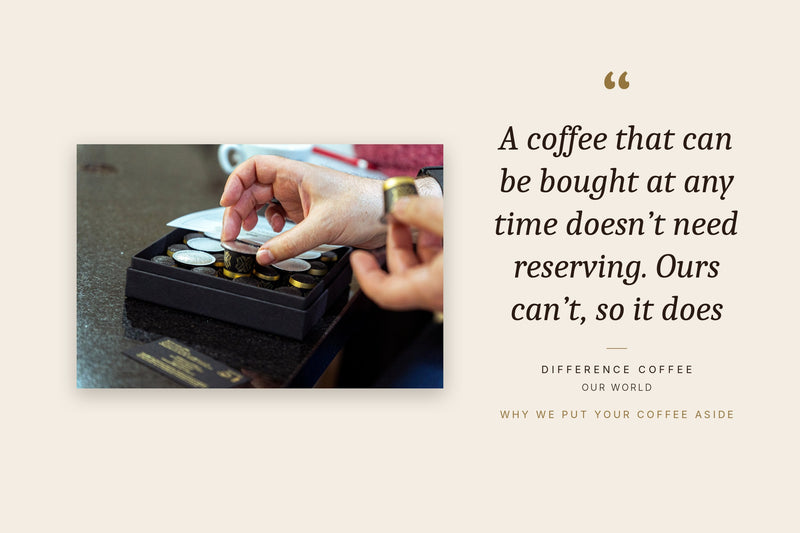
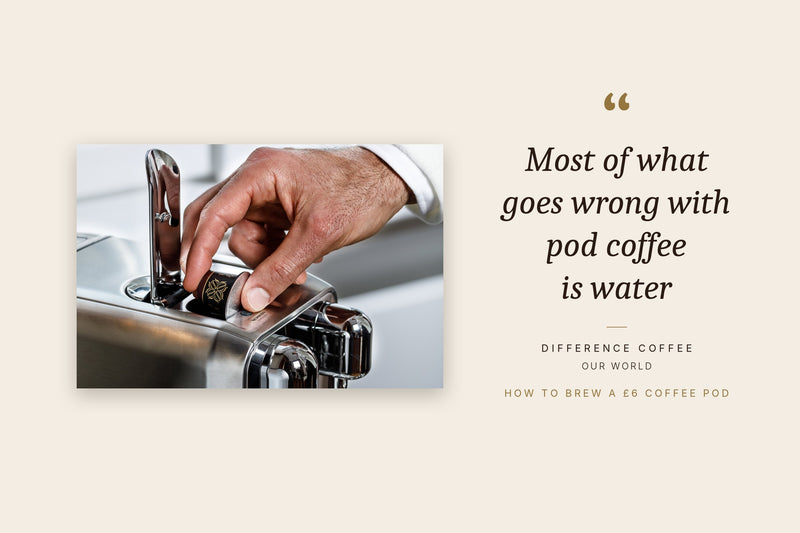
Our Wild Kopi Luwak comes from Gayo Estate, and every lot we buy arrives with its certificate. Other producers may make some of the same claims; we know of none that can show all three together: specialty grade by SCA standards, a lot-specific MPKG wild certificate, and farms independently audited every season. We roast it, rest it, then grind and seal each single portion in a nitrogen-flushed capsule at peak freshness. A box of ten Nespresso Original compatible pods is £50, five pounds a cup, brewed at the 25ml ristretto setting.
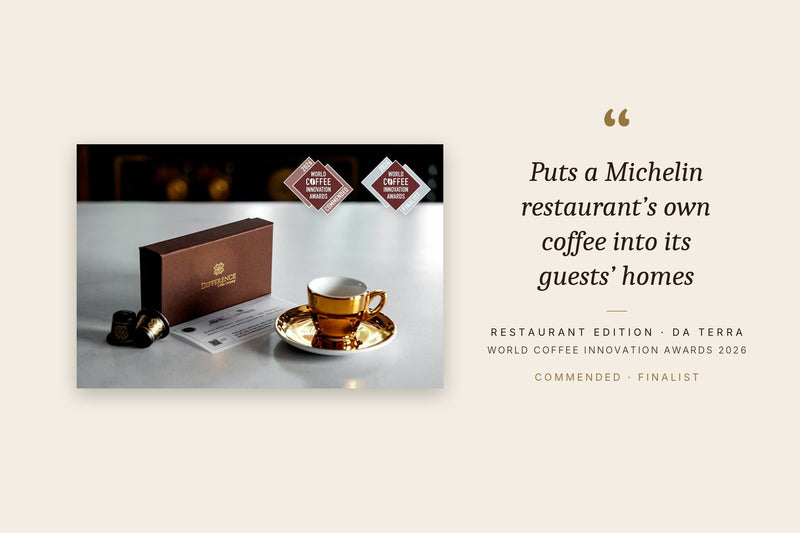
And the story would not matter if the cup did not hold up. It does: full-bodied, with gentle acidity and low bitterness, and tasting notes of forest woods and dark cocoa, a profile that takes milk beautifully. The coffee is specialty grade and hand-sorted, and every lot is cupped independently by the Gayo Cuppers team before export. The current lot scored 84.75 with zero physical defects, well above the 80-point threshold at which coffee qualifies as specialty. It was awarded Grand Gold at Monde Selection 2026 and Double Gold at the Aurora Challenge 2025, and the same capsules are served in more than 100 Michelin-starred restaurants.
Questions we get asked
Is any Kopi Luwak ethically sourced?
Yes, but only the wild-collected original, and it is the minority of what is sold. Before buying any Kopi Luwak, ask for four things: a named estate or cooperative, a named certifier you can look up, a lot-specific certificate rather than a blanket claim, and evidence of a wild diet in the raw material. If a seller cannot produce them, the welfare organisations' advice stands: do not buy it.
How can you tell wild Kopi Luwak from caged?
Start with the droppings. A wild civet's varied diet leaves coffee beans mixed with the seeds of other fruits; a caged civet's droppings are almost entirely coffee. No single check is proof on its own, which is why certified lots pair that examination with documentation of the farmer and the collection location. Scarcity is the other tell: wild Kopi Luwak is collected in small batches at a steep premium, so a cheap one, or one available in quantity all year round, is telling you how it was made.
Can you get Kopi Luwak in pod form?
Yes. Ours is, to our knowledge, the only certified wild Kopi Luwak available in Nespresso Original compatible pods: a single cup's worth, ground and sealed at peak freshness, with no need to buy a large bag of one of the world's most expensive coffees to find out what it is.
Why is Kopi Luwak so expensive?
Because the wild version cannot be scaled. Collectors are paid four to five times the conventional price for coffee gathered in small batches before sunrise, and much of what they gather is removed in sorting. Gayo Estate's entire wild harvest for 2026 is roughly 200 kilograms. Scarcity is built into how it is made, and a cheap Kopi Luwak has solved that problem in the only way it can be solved.
Do these work in a Nespresso Vertuo?
No. Nespresso Original machines only.
More from Our World